Wednesday, June 25, 2014

India : YC-Backed ClearTax Tackles India’s Fast Growing Online Tax Filing Market

Catherine Shu for TechCrunch writes: ClearTax is not the typical Y Combinator launch. Founded in 2011 and based in Delhi, the startup already has a strong presence in India, where it automates the income tax filing process for workers. Last year, over 300,000 people used ClearTax to file their taxes. Furthermore, the company is also the first one focused specifically on the Indian market to join Y Combinator (though the program has accepted other, more internationally-focused startups with India-based founders before).

While their market opportunity is currently in India, ClearTax decided to join Y Combinator because the startup got access to “a set of resources we don’t get in India,” says founder Archit Gupta.
“We were missing some of the mentorship in India for example. I worked in Silicon Valley before. I was an engineer at Data Domain, which was acquired by EMC. So I had seen how being in the Valley is super useful, so that whole thing made it very, very clear to us that we should come out here.”
Since it’s currently tax season in India, ClearTax’s nine-member team has split their time between California and Delhi. Gupta started ClearTax with his father Raja Ram Gupta, a chartered accountant; Srivatsan Chari; and Ankit Solanki.

India’s Push To Get All Tax Filings Online

ClearTax wants to expand beyond India eventually, says co-founder Archit Gupta, but right now there the country presents a fast-growing opportunity thanks to the government’s goal of making all tax filings online by 2016, which means that 42 million people will be filing their income taxes electronically in about a year. Furthermore, four million new taxpayers join the workforce every year and the projected rate of increase in the number of e-filers is 9% year over year.
“Twenty million filed online a couple years ago, 27 million last year, and I think it will be 30 to 35 million this year,” says Gupta. “For us, that’s one of the very key drivers of growth. It’s basically forced by the government saying we want everything electronic.”
E-filing in India is already six years old and there are several other companies that offer online tax services. To differentiate, ClearTax decided to look at e-filings as a “software problem,” says Gupta. They also created a simple user interface with a slightly irreverent tone to mitigate the tediousness of filing taxes.
“Before we existed, before ClearTax existed, nobody, I think, had taken a look at the tax filing product like from a software perspective,” says Gupta.
India’s version of the W2 form is called Form 16, or F-16. To use ClearTax, all someone needs to do is upload the form onto the website. Then ClearTax’s software automatically pulls out relevant data, so users don’t have to manually key in any numbers or information, and prepares tax forms for each user, a process the startup says can take as little as 15 minutes. 

Gupta says ClearTax’s main competitor is the government, which has its own online filing software, but that’s complicated to use, especially since people need to figure out which one out of seven tax forms they need to fill out. ClearTax also competes with HR Block, which launched a website in India last year for tax filings, as well as startupsTaxmile.com and Taxspanner.com.
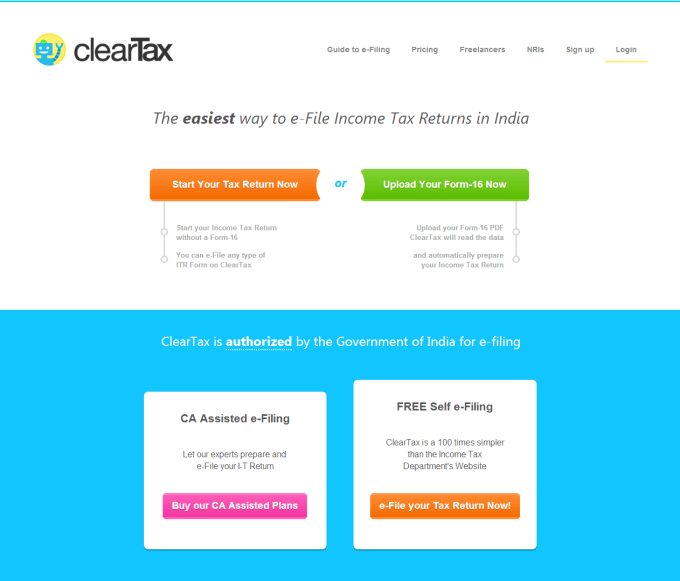
cleartax-home-page
ClearTax’s competitive advantage is making the process of filing taxes easier and faster, with less steps and potential headaches for individual users, says Gupta. For example, if someone has a question about certain field in their tax form, they can leave it blank and then ask one of the 70 chartered accountants ClearTax works with for help.

How ClearTax Gets Users

While the startup’s business model is B2C, it uses a B2B model to find users by reaching out to large corporations, which then offer ClearTax for free or at a discount to their employees. These companies currently include the Royal Bank of Scotland, as well as major startups like InMobi and Flipkart.
Unless someone gets an employee discount from their company, self-filing costs between $4 to $5, while an assisted filing, in which a user gets help from a certified public accountant, costs $10 to $100 depending on the product and complexity of the tax return.
One of ClearTax’s biggest growing markets are Indian citizens living in other countries, who have a service made specifically for their needs that costs $40. Another is ClearTax’s products for businesses, which are currently targeted toward freelancers and small businesses. Most of ClearTax’s enterprise clients are freelance photographers or work in tech-oriented industries, including web design and development. ClearTax’s accountants help them claim expenses, which in turn can increase the amount of their tax return, by asking them questions with a phone call.
Gupta says that ClearTax has a “strong partnership with the government in the sense that they give us the APIs and then they are pretty hands off. They don’t get involved, they don’t try to. It’s pretty good a relationship with the government, so we actually think the government is focused on making things simpler for the country.”

Growing Beyond Tax Filings

After 2016, when all tax filings are online if the government’s initiative goes according to plan, Gupta says ClearTax will start working on software-driven personal finance products.
“We don’t just want to get into selling off funds or investment instruments. There has to be a value addition via software, like WealthFront, the fin-tech company Adam Nash is helping to build that says it will use software to tell people how to invest and it will have a very small carry and just be mutual funds. That to me is a much more exciting model and it’s a very new way of thinking.”
In the near future, ClearTax will focus on building mobile software, including tools that will allow people to file their income taxes using only their phone. Gupta says much of ClearTax’s website traffic already comes from people browsing on their Android devices.
“Next year, we will crack the code in getting people to file on their phones because we can do optical-character recognitions. Once someone uploads a photo of their F16 or emails it to us, it’s really a very small amount of data,” says Gupta. “We see a very strong rise in Android traffic on our website and we know it’s very important for us to be there for our users in that aspect.”
Posted on 6:49 AM | Categories:

Even Small Business Owners Can Use These Tax Breaks

Steve Parrish for Forbes writes: Two recent news clips caught my attention. One involved a company trying to avoid the IRS. The other involved the IRS trying to avoid trouble. Taken together, I can see how a small business owner might cynically ask if a small business has a fighting chance as far as taxes.


The first news item was about the latest rage in large company tax planning: “tax inversions.” U.S. companies seek to sidestep U.S. corporate taxes by relocating offshore through foreign mergers. The most recent example is the proposed Medtronic/Covidien merger. Even though Covidien has headquarters in the U.S., officially it is located in Ireland where the top marginal tax bracket is 10% lower than in the U.S. Apparently Medtronic hopes to save taxes by merging with an Ireland-based company.
The second news item relates to an ongoing scandal where the IRS is accused of targeting certain not-for-profit organizations because of their political leanings. The IRS announced this month that it can’t find two years of emails from Lois Lerner (the former head of the troubled not-for-profit tax division) to the Departments of Justice or Treasury. An agency spokesman blames a computer crash.
These kinds of stories raise the ire of small business owners. It sometimes just doesn’t feel fair. The big guys play “name that country” and the tax regulator, allegedly, chooses who to chase. However, before becoming cynical, embracing bogus tax scams or giving up, I’d ask this question:  Are you taking advantage of the legal tax breaks that are afforded you? In other words, forgetting about what big companies are up to and putting aside your doubts about the IRS, have you truly worked with your tax advisor to leverage available tax breaks? In many cases, you don’t have to use gimmicks and play games.  You just need to ask yourself if you’ve thought through all the opportunities.
Do you have the right tax structure? Consider the IRS data for 2012 tax returns: 1.9 million companies filed as some form of C Corporation, 3.6 million filed partnership returns (presumably many of them being LLCs) and an impressive 4.6 million filed as S Corporations. Before worrying about what big company moved which assets where, have you made sure you are not paying double taxes by being a C Corp? Could you save on payroll taxes if your LLC files as a corporation and elects S Corp status? Have you structured your business to be active, versus passive, in order to avoid the Net Investment Income tax?
Are you using the tax breaks often available to small businesses? Have you considered the Small Business Health Care Credit? It has been reported that this credit has low utilization in part because of its complexity. There are a number of available government and association tools that can make calculating this credit less daunting. Are you aware that the rules for the Home Office deduction have been liberalized, and can be utilized by more self-employed business owners? Similarly, are you still taking the per mile deduction for travel when it may be more advantageous to itemize your transportation expenses? What about hiring your spouse and children to work in your business? In many cases, there are ways to legitimately save taxes by having family members on the payroll.
Have you maximized what you can do with fringe benefits? There are some basic blocking and tackling techniques with fringe benefits that can save taxes. Whether it is life insurance, disability income insurance or long-term care insurance, there are ways to structure and pay for these benefits that can benefit your personal taxes. And, qualified plans offer a myriad of designs that can be tax-smart as well.  Contrary to popular opinion, there are legitimate qualified plan designs that can disproportionately favor older and/or higher paid employees.
Have you looked at how you can save taxes on your exit plan? I often point out a business owner has a range of buy-out planning options that can vary from the plan being entirely non-deductible to being 100% deductible. So, for example, if I buy out my partner’s stock for a lump sum, it’s a capital purchase, and none of my payment is deductible. If, instead, I sell my business to an ESOP, potentially all of my gain is deferred plus the company can deduct all of its payments to me. Needless to say, there are buy-out design concepts that fall in between these two extremes from a tax-leveraging standpoint.
So before you get too caught up in political debate about what’s fair … and unfair … in taxes, I suggest you make the most of tax opportunities already available to you. The Clinton family is a good example. Both Bill and Hillary Clinton have been vocal about their belief in the need for a federal estate tax. This has not, however, kept them from maximizing their own estate tax savings planning. The Clintons created residence trusts in 2010 and shifted ownership of their New York house into them in 2011. These planning steps can help wealthy families reduce the sting of the 40% federal estate tax.  As Justice Learned Hand so eloquently stated, “There is not … a patriotic duty to increase one’s taxes.”
Posted on 6:48 AM | Categories:

XERO : Introducing Federal e-file for US Payroll

Oliver Furniss for Xero writes: Today we’re pleased to announce the release of Federal e-file in US Payroll. Back in April we released the first version of Taxes & Filings. This provided you with signature ready completed tax forms to ensure you could meet your filing obligations.

Easily meet your Federal payroll tax obligations with Federal e-file

With Federal e-file, Xero creates and electronically files your Federal payroll tax forms for you. This allows you to file with the IRS online, at anytime from anywhere to meet your filing obligations. Federal e-file is available to customers on Premium pricing plans. To use Federal e-file it’s required that you enroll your business with Xero. For instructions on how to enroll please click here.
Xero Payroll Federal e-file
Although we’re not yet at our goal of making everything electronic, we’ve achieved a key milestone in this release with Federal e-file. We’re now focused on bringing you Federal electronic payments and other key improvements to continue to strengthen the experience.
Our vision is to provide you with the worlds best payroll experience for small businesses, in all states, allowing you to manage your payroll; easily and without fear. However, at this time we have no plans in the short term to support more states as we focus on the experience in the current states. With our Payroll Add-Ons you can still benefit from using Xero by using one of our integrated partners to manage your payroll.
For full details please check out our release notes or read more instructions in our Help Center.
Posted on 6:48 AM | Categories:

Tuesday, June 24, 2014

5 Signs It’s Time to Ditch Excel Reporting

Michal Wachstock for Sisense writes: Excel is the most popular spreadsheet software in the world, with hundreds of millions of users. Yet while Excel’s simplicity of organizing data has made it the most frequently used reporting tool, it doesn’t take long to accumulate “Big Data” far beyond Excels capacity. Then, you are left to work with desktop spreadsheets that don’t enable real-time data sharing, updating, or show you a complete picture of all data in your organization. More businesses are moving away from Excel and adopting a dedicated reporting software designed for the more advanced needs of organizations today. If you can relate to one or more of issues below, it’s probably time to upgrade your reporting as well.

1. Excel is getting slow

Excel can become sluggish when reports contain more data than Excel was designed to handle. Size impacts the time it takes an Excel document to load as well as to the time it takes to make any change to the data inside the document. Today, almost every business that is actively collecting data just for their marketing and sales departments, can easily accumulate data beyond Excels capacity.
When this happens, users tend to break data into smaller, more manageable segments, or maintain multiple workbooks or worksheets, both of which are almost impossible to consolidate. Not only does this make reporting more difficult, but it also takes valuable time away from other tasks. The bottom line? Because it’s so hard to accurately join all your scattered datasets, you’ll never get a complete view of your organization–whereas with a BI and dashboard reporting software, seeing the bigger picture can be simple.

2. There’s debate over report accuracy and ownership

Excel users typically store files locally on their computer for reporting purposes. If several people want to work on a report using the same data, they must all have identical copies of the file.
This might not seem like a big challenge—after all, sharing files via email is fairly simple. However, changes to some of the cell values are inevitable and once a file is shared and an analyst begins building a report, those changes are hard to implement. With a few users working on the same report, each person maintains a different version of the file, with slightly different data, leading to a debate over who has the most accurate data. Managing reports with multiple users and versions will at best give you a massive headache, and at worse give you inaccurate information and insights.

3. Manual updates are time consuming and error-prone

Updating data in an Excel file is rarely a simple task because adding fields, copying formulas and data values can break pre-set functions. Adding new data with an additional field (column) typically means that same field must be created for pre-existing data.
If analysis is spread over several sheets in a workbook, it’s likely that each sheet will require changes based on that additional field. And if sheets reference one another, adding a field to one sheet can be a confusing and complicated task as it’s not easy to see which data is affected by the addition. Wasting time on “cleaning up” data so it synchronizes properly is a mindless task that is always fallible.

4. Your KPIs cannot be calculated with one Excel formula

The most powerful KPIs require formulas that reference several dimensions or columns and use complex and nested filters. When it becomes impossible to calculate KPI results with a single Excel formula, reporting becomes a time-consuming, manual exercise.  In other words, to make meaningful KPI dashboards, you need to move beyond the built-in functionality of Excel.
The longer it takes you to build and maintain a report, the less frequently you’ll be able to use the insight it provides to develop strategy. Longer reporting intervals cost your organization time and prevents it from reacting to change in real-time.

5. Reports and dashboards aren’t inspiring

While Excel offers data visualization tools for data sets that are small and simple, once the data sets grow, these visualizations become static and almost unpresentable. Poorly designed data visualization, even for no-frills charts, isn’t just uninspiring—it can also be misleading.
In this aspect, you’re truly missing out because high quality data visualization makes it very easy to see patterns or changing trends with a single glance. In effect, it turns columns and rows of data which have limited meaning and require close study into a format that the human brain can process almost instantaneously.

Bottom line

As you see, it doesn’t take a lot of data or very complex data to outgrow the size and scope of ExceI. If you’ve identified with more than one of the five pain points above, it’s time to ditch Excel for a more robust business intelligence solution. True business intelligence tools can handle data on a gigabyte to terabyte scale, create a single version of truth from your multiple data sources, and deliver beautiful data visualizations that will allow your organization to make critical decisions in real-time.

SiSense is an award-winning, full-stack Business Intelligence and Analytics software that's creating quite a buzz for its powerful technology as SiSense is the only fully-functional Business Intelligence tool that lets non-techies join multiple large data sets, build smart dashboards with great data visualizations, and share with thousands of users.
Posted on 9:35 AM | Categories:

Tax Considerations When Filing For Divorce

Aaron Weems for Fox Rothschild writes:  Aaron Weems' article "Tax Considerations When Filing for Divorce" was published in the June 2014 issue of The Matrimonial Strategist. A synopsis is noted below.

Most people do not base their divorce or separation around tax-planning options. Tax issues are often left until an asset is sold, or the end of the year approaches without the prospect of a divorce decree being issued. Some tax liabilities should not be afterthoughts. This article highlights tax liabilities that can be of particular importance during a divorce.

Child Exemptions – Who gets to claim children on taxes is a frequent debate between parties. Some states allow their courts or domestic relations offices to assign exemptions between the parties while some are reluctant to make such a determination, and instruct the parties to follow IRS regulations.

Child Tax Credit – The Child Tax Credit is perhaps the most easily identifiable tax issue that arises during a divorce. Who may claim the child is a major area of dispute between parties.

Sale of the Marital Residence – The sale of the "main home" is a common occurrence in divorce cases. When a main home is sold, the IRS allows capital gains to be excluded from income taxes; a benefit that, when planned correctly, can create a significant opportunity for both parties to maximize their portion of the sale proceeds.

The Innocent Spouse and Relief from Joint Liability – Due to divisions of labor and responsibilities in marriage and relationships, one person will know, but not really know, how their finances work. For separated and divorced individuals, there is relief available through the IRS to alleviate a joint tax liability under certain circumstances.

Deducting Legal Fees Related to Divorce – Another difficult reality of litigating a divorce case with significant or complicated assets is that the parties are responsible for paying those legal fees with their post-tax income. As a general premise, people cannot deduct legal fees related to a divorce. However, the IRS does allow for the deduction of fees related to the taxpayer's obtaining taxable alimony.
Posted on 9:21 AM | Categories:

UK: New Resource Launches to Help Find the Best Cloud Bookkeeping Services / The Cloud Bookkeeping website aims to rate and review the best cloud accounting services to help consumers find the best option for their needs.

The online Cloud Bookkeeping resource hub has been newly launched to help freelancers and self-employed workers to take charge of their accounts and harness the power of cloud computing in order to better managing their finances. 
 
The website which can be found at http://www.cloudbookkeeping.org.uk/ has gotten off to a busy start by offering plenty of advice to those who are interested in learning more about cloud bookkeeping and cloud accounting. The first portion of the website is devoted to explaining and demystifying this modern approach to bookkeeping, covering how the services work and why it can be a good choice for many individuals and business organizations.

As the website has evolved and expanded over the short period it has been live, the team have been busily reviewing and evaluating a selection of the best and worst online cloud book keeping services available to individuals and small groups. This published advice not only covers the main contenders in great detail, but also provides a lot of advice for evaluating the options according to the needs of the customer. 

When speaking to the team behind the website, the inspiration for the website and their future plans were readily shared. “Everyone keeps hearing about the cloud and cloud computing but not many people correctly know what it means,” the site founder of the website noted. “When we began looking into the different cloud services online, it became clear that cloud bookkeeping and online accounting were the main areas where traction was really being found,” he continued. “That told us that there must be a lot of people out there that could benefit from these services, but might not be sure how best to harness them or even that they need them, and thus the website was born,” the shared further.

When looking at the different online service providers in this growing sector, the website team were able to clearly pick out a handful of options that offered the best range of services and usability at a fair price. These options all made their way to the comprehensive guide to the top 5 online accounting software leader board which includes such eminent names as Cloud Bookkeeper, Cloud Bean Counter, and Fresh Books. With so many options to choose from, the website aims to simplify the selection process and arm consumers with the information they need to make the right decision for their needs and the needs of their company or the services they offer.

Future plans for the website include working with those offering these cloud-based financial services and establishing promotions and discounts for the readers of the website. Although these deals are yet to be finalized, it is expected they will include free trials and discounts on the price of the most popular online bookkeeping services out there.

With many more users turning to the cloud for their business needs, it appears that sites like Cloud Bookkeeping will continue to play an important role in informing and educating customers in the options available to them, in order to help them find the best solutions for their needs.
Posted on 7:41 AM | Categories:

New Zealand Stock Exchange probes Xero price drop / Xero responds to price inquiry

TOM PULLAR-STRECKER for Stuff.co.nz: Xero has brushed off a "please explain" letter from the NZX issued in response to a 21.5 per cent drop in its share price between June 16 and this morning. 

The software company noted that its shares had since added $2 and said it was complying with its continuous disclosure obligations. 

Shares in Xero slid from $29.31 to bottom out at $23 this morning before recovering. The shares were trading at $24.83 this afternoon, valuing the company at $3.2 billion. 

It confirmed it would issue a revenue forecast for its 2015 financial year at its annual meeting next month. 

Xero issued an update on June 16 that said its annualised monthly revenues had increased from $93 million to $100m between March and May. 

One analyst speculated that the increase may have been viewed by investors as disappointing, and a subsequent decline in its share price may have triggered panic selling by some retail investors. 

Xero told the NZX its shares were subject to significant volatility because of its tightly held share register. 

In March and April, there was a "substantial general rerating" of cloud-software stocks, but Xero was confident in its growth strategy, chief financial officer Ross Jenkins said.


Xero responds to price inquiry
AAP for Local Today writes: Xero has responded to a stock market operator price inquiry after the New Zealand cloud-based accounting software firm fell to an eight-month low in morning trade.

The NZ stock market regulator issued a "please explain" notice to Xero over a 22 per cent, or $NZ6.31, decline in its share price since June 16 to an eight-month low $NZ23 at 11am (0900 AEST)on Tuesday.

The stock has "historically been subject to significant volatility as a result of its tightly held share price," and Xero complies with continuous disclosure rules, the Wellington-based firm's chief financial officer Ross Jenkins said in a letter to the regulator.

"Since the $180 million capital raise at $18.15 in October 2014, Xero's share price has been on a rapid upward trend, in part driven by increased global investor exposure and the inclusion in various large global indices," Mr Jenkins said.

"In March/April this year, the market saw a substantial general re-rating of software-as-a-service stocks, which impacted Xero's share price."

Xero pared its morning losses and was down 4.3 per cent to $NZ24.80 in early afternoon trading.

The Wellington-based firm has fallen 46 per cent in the past three months, from an intraday record of $NZ45.99 in early March, and was one of a group of growth-orientated stocks under pressure on Tuesday.

Dunedin-based biotech company Pacific Edge declined 6.2 per cent to an eight-month low of NZ76 cents and has plunged 49 per cent in the past three months.

"All the growth stocks continue to be chasing the same pool of investors with all the new listings coming on the market as well," said Bryon Burke, head of equities at Craigs Investment Partners.

"There are a lot of growth stocks around and they seem to be losing favour at this stage and there are more coming onto the market and that seems to be where the money is heading, to the new ones."

Online business travel booking company Serko debuted on the NZX on Tuesday at $NZ1.10 before sliding nine per cent to $NZ1.
Posted on 7:41 AM | Categories:

The Implications Of A K-1 Tax Form When Trading ETPs

Nathan Buehler for SeekingAlpha writes:

Summary

  • A relatively small portion of ETPs issue a K-1 tax form.
  • K-1 forms are often misunderstood.
  • Checking the previous and current financial performance of the fund can help you plan for your year-end tax liability.
A Seeking Alpha user recently contacted me about a question regarding the K-1 tax forms on ETPs.

Let's begin with the obvious question. What is a K-1 tax form?
A K-1 tax form shifts the liability for income taxes from the ETP entity to those who own/have owned shares. You are essentially a limited partner in the ETP. This makes you responsible for a portion of the capital gains or losses accrued by the ETP.
Relatively, few ETPs issue a K-1 tax form.

Things you need to know and tips for K-1 forms:
  1. K-1 forms are usually the last forms to be sent out. This could delay your tax filing.
  2. If you are holding shares in a tax exempt IRA, usually, you will not be required to report this income on your tax return.
  3. You may receive a K-1 form even if you have not yet sold your shares.
  4. Always contact a tax professional for year-end advice regarding a K-1 form.
While researching this question I found some great informational links:
Charles Schwab
ProShares
Generally, we fear what we do not know. I can tell you that the concept of the K-1 form took me several days to grasp. Here is my equitable advice for you:

1. You can use options instead of directly purchasing shares in the ETP. This will bypass the K-1 form at the end of the year because you never directly held shares in the ETP. Options of low volume ETFs are usually not priced well. The bid/ask spread tends to be very wide. Please keep that in mind before jumping into options trading. To research more about options trading, use this resource.

2. Read through the prospectus and monitor the monthly gains/losses. You may sell an ETP for a loss, but log a capital gain because of the fund's monthly performance. Some ETPs calculate your portion of taxes on a pro-rated monthly basis instead of your actual ownership time.

3. If you don't understand the implications of a K-1 tax form, read the above links, below prospectuses, talk to a tax professional, or choose an alternative investment vehicle.
I have compiled a list of the ETPs that currently issue a K-1 tax form. I have researched whether the ETP is optionable or not. Included is a link to each funds' latest financial profit/loss statement (note that some funds are up to two months behind). The financial statement is a good indication of whether your K-1 will include a profit or loss amount for that time period.

Name of fundTickerOptionableLink to latest financial statement
PowerShares DB Commodity Index Tracking Fund(DBC)YesHere
PowerShares DB Agriculture Fund(DBA)YesHere
iShares S&P GSCI Commodity-Indexed Trust Fund(GSG)YesHere
PowerShares DB USD Index Bullish(UUP)YesHere
United States Natural Gas Fund LP(UNG)YesHere
United States Commodity Index Fund(USCI)NoHere
United States Oil Fund(USO)YesHere
ProShares Ultra Silver(AGQ)YesHere
ProShares UltraShort Euro(EUO)YesHere
PowerShares DB Energy Fund(DBE)YesHere
PowerShares UltraShort DJ-UBS Crude Oil(SCO)YesHere
PowerShares UltraShort Yen(YCS)YesHere
GreenHaven Continuous Commodity Index Fund(GCC)YesHere
PowerShares DB Oil Fund(DBO)YesHere
PowerShares Ultra VIX Short-Term Futures ETF(UVXY)YesHere
PowerShares DB Base Metals Fund(DBB)YesHere
PowerShares Short VIX Short-Term Futures ETF(SVXY)YesHere
PowerShares DB Precious Metals Fund(DBP)YesHere
PowerShares DB G10 Currency Harvest(DBV)YesHere
PowerShares DB Gold Fund(DGL)YesHere
ProShares Ultra Gold(UGL)YesHere
ProShares VIX Short-Term Futures ETF(VIXY)YesHere
ProShares Ultra DJ-UBS Crude Oil(UCO)YesHere
ProShares UltraShort Gold(GLL)YesHere
Teucrium Corn Fund(CORN)YesHere
United States 12 Month Oil(USL)YesHere
ProShares UltraShort Silver(ZSL)YesHere
ProShares UltraShort DJ-UBS Natural Gas(KOLD)YesHere
PowerShares DB USD Index Bearish(UDN)YesHere
United States Brent Oil Fund(BNO)YesHere
ProShares VIX Mid-Term Futures ETF(VIXM)YesHere
United States Gasoline Fund LP(UGA)YesHere
PowerShares DB Silver Fund(DBS)YesHere
ProShares UltraShort Australian Dollar(CROC)YesHere
ProShares Ultra DJ-UBS Natural Gas(BOIL)YesHere
United States 12 Month Natural Gas Fund(UNL)YesHere
ProShares Short Euro(EUFX)YesHere
Teucrium Wheat Fund(WEAT)YesHere
United States Short Oil Fund(DNO)YesHere
Teucrium Soybean Fund(SOYB)YesHere
United States Copper Index Fund(CPER)NoHere
Direxion Daily Gold Bull 3x Shares(GLDL)NoHere
Direxion Daily Gold Bear 3x Shares(GLDS)NoHere
ProShares Ultra Australian Dollar(GDAY)NoHere
United States Diesel Heating Oil Fund(UHN)NoHere
ProShares Ultra DJ-UBS Commodity(UCD)NoHere
ProShares Ultra Short DJ-UBS Commodity(CMD)NoHere
Teucrium Sugar Fund(CANE)NoHere
United States Agriculture Index Fund(USAG)NoHere
ProShares Ultra Euro(ULE)YesHere
United States Metals Index Fund(USMI)NoHere
Teucrium WTI Crude Oil Fund(CRUD)NoHere
Teucrium Agricultural Fund(TAGS)NoHere
ProShares Ultra Yen(YCL)YesHere
Teucrium Natural Gas Fund(NAGS)NoHere

Lastly, what are the actual implications of the K-1 form? At the end of the year, you will receive a 1099B from your brokerage and a K-1 form for your investment in any of the above ETPs. It will be out late (typically February-April). Per Turbo Tax, you will only need to report the amount listed on the K-1 form. You can cancel out the profit/loss listed on the 1099B.
K-1 forms should not keep you from investing in a fund, assuming you believe it is a good investment. It is just a different kind of tax reporting at the end of the year. Nothing to be afraid of, just something to be educated about.

Final note: I am not a tax professional. All information contained in this article is informational and based on my own research. I recommend you contact a tax professional for help regarding your end of the year K-1 tax form.
Posted on 7:34 AM | Categories: