Sunday, June 22, 2014

Tips for Deducting Charitable Donations / Record-Keeping Rules Vary Depending on Several Factors

Tom Herman for the Wall St. Journal writes: If you want to deduct charitable donations on your federal income-tax return, pay attention to some often-overlooked fine print. Record-keeping rules vary depending on the size of your gifts and whether they're cash, noncash or out-of-pocket expenses for donating services.
A few pointers on cash gifts:
-- Even if you make a tiny gift, get proof, such as a "bank record." That may include canceled checks, bank or credit-union statements, or credit-card statements showing the recipient's name, the date and amount of the gift. Or get a receipt showing the charity's name, the date of your gift and the amount. If your return is audited, receipts are very important.
-- If you give $250 or more to a qualified organization during the year, make sure you have an acknowledgment, or payroll-deduction records, as documentation for your gift.
-- For gifts of $250 or more, make sure the acknowledgment says how much you gave and whether you received goods or services in return (other than what the IRS calls "token items and membership benefits"). If you got something in return, such as opera tickets, the acknowledgment should describe it and estimate its value. You typically can deduct only the amount that exceeds the value of what you received.
Even if you didn't get anything in return, the receipt should say so ("no goods or services were provided in exchange for this gift"), says Martin Hall, a lawyer with Ropes & Gray. Get that acknowledgment by the date you file your return for the year you make the gift (or the due date, including extensions, for filing the return, whichever is earlier). "It's too late to get it after your deduction has been questioned on audit," Mr. Hall says.
Don't worry about any of this if you choose the standard deduction, as nearly two-thirds of taxpayers do. If you do, you can't deduct charitable gifts.For more, see the IRS website (www.irs.gov).
Posted on 6:12 AM | Categories:

IRS Announces New “Penalty-free” Program for Delinquent Expats

Joshua Ashman for ExPatProfessionals.com writes: On June 18th, the IRS announced significant changes to the current Streamlined program.  As many of you may know, since June 2012, delinquent U.S. expats were afforded the opportunity to catch up on their U.S. taxes and FBARs (Foreign Bank Account Reporting) without being subject to penalties and by filing only a limited number of tax returns and FBARs.  However, the criteria for qualifying for the Streamlined program were very rigid and narrow, essentially leaving many U.S. expats “out in the cold” with the only real (i.e., legal) option of going through the more costly and gruesome OVDP (Offshore Voluntary Disclosure Program).

Effective July 1, 2014, this has all changed.  The IRS has gone away with several of the more challenging criteria and has essentially opened up the Streamlined program to any U.S. expat who can certify that their prior non-compliance was non-willful.  In addition, the IRS will no longer require the risk questionnaire and has eliminated the $1,500 tax liability threshold.

What does all of this mean?  In a nutshell, thousands of U.S. expats who have innocently failed to file tax returns or FBARs and who can establish that they did so without any intent to cheat the IRS or evade paying taxes, can now start fresh by filing three years of missing tax returns and six years of missing FBARs without being subject to penalties.  More information can be found in the revised FAQs published by the IRS here


In addition, the IRS has published a special FAQ list covering transition rules for those who are already in the OVDP.  These FAQs can be found here 


In the coming days and weeks we will be closely following these changes and will update our website with more detailed information and insights regarding the Streamlined program.
If you happen to have fallen behind on your U.S. tax returns or FBARs, these modifications present a tremendous opportunity for you to come clean and start fresh without paying penalties.  At Expat Tax Professionals, we’ve been assisting U.S. expats all around the globe with catching up on their U.S. taxes via both the Streamlined program and OVDP and we’re happy to hear from you in order to see how we can be of assistance in your case.
Posted on 6:12 AM | Categories:

Saturday, June 21, 2014

What is your favorite accounting software? What attracted you to it?

Young Entrepreneur Council writes: The following answers are provided by the Young Entrepreneur Council (YEC), an invite-only organization comprised of the world’s most promising young entrepreneurs. In partnership with Citi, YEC recently launched StartupCollective, a free virtual mentorship program that helps millions of entrepreneurs start and grow businesses.

Windsor Hanger1. QuickBooks Online

“I love using QuickBooks online because it is available wherever I am, it’s easy for my accountant to log in with her own permission set (that I assign) and it easily integrates with all of my bank and credit card accounts.”
Windsor HangerHer Campus Media


Matt Mickiewicz2. Xero

“At Hired, we’ve found that connecting our bank accounts and credit cards with Xero has been great. Expenses automatically get categorized, reconciliations are one click and there are integrations with companies like Expensify and Bill.com — both of which we also use at our company.”
Matt MickiewiczHired

Daniel Wesley3. Mint

“For personal use, I always stand by Mint. It’s intuitive, easy to use and free. The hardest part of any accounting software is making sure you use it consistently, but Mint makes that simple by offering the software in the form of multiple apps.”
Daniel WesleyCreditloan.com


Patrick Conley4. Bench

“We used to use QuickBooks but felt it was too slow and dated. We switched to Bench, which is cloud based, fast and comes with a bookkeeper to manage the accounting basics for us. I love this service! It provides the “need to know” info for us, and they take care of the rest.”
Patrick ConleyAutomation Heroes

Wade Foster5. inDinero

“I like inDinero because it does everything automatically. What more could you want?”
Wade FosterZapier


David Ehrenberg6. QuickBooks Hosted

“There’s a reason that QuickBooks is still used by 80 percent of our clients. We put our clients on a hosted version rather than online because it’s more robust and offers great functionality. Companies can access it anytime, anywhere. I also like QuickBooks because there’s a product for every stage and level of financial complexity.”
David EhrenbergEarly Growth Financial Services

josh weiss7. FreshBooks

FreshBooks is a simple, cloud based accounting software that makes it quick and easy to get all of your finances in order. It’s reasonably priced and has support for lots of third party apps to integrate all aspects of your business in one place.”
Josh WeissBluegala
Posted on 3:30 AM | Categories:

Betterment for advisers on its way as firm adds trust, tax-loss harvesting products / Betterment Institutional for advisers will launch by early 2015, CEO says

Joyce Hanson for InvestmentNews.com writes: As online investment manager Betterment gears up to introduce an institutional-level platform designed for financial advisers by early 2015, it launched trust and tax-loss-harvesting products for retail customers.

Betterment Institutional, the new platform for advisers, is now in beta testing with the help of about a dozen registered investment advisers, according to company officials. The broader launch will come sometime around the end of this year or early next year, said Chief Executive Jon Stein, who believes his so-called “robo adviser” can be a useful online tool for human advisers to use in tandem with clients.
“Our belief is that there are a number of people who rightly value what advisers bring. They value the personal relationship and the consultation about life's goals, and they value estate planning and tax planning. All of those services are best provided by an adviser,” Mr. Stein said.
Betterment built its trust fund tool because many of the company's 38,000 customers already have trusts and have requested an easier, low-cost way to manage them, according to Betterment product manager Nick Gavronsky, who noted that a customer can have an unlimited number of trusts with a single online login.
“Our fees aren't eating away into the trust's assets,” Mr. Gavronsky said. “We automate the fiduciary responsibility of the trustee.”
Betterment's automated investment service puts customer assets into index-tracking exchange-traded funds. The service costs 0.35% of a customer's average annual balance for a $100-per-month minimum auto-deposit, 0.25% on a $10,000 minimum balance and 0.15% on a $100,000 minimum balance.
Both the trust and tax-loss harvesting products are available at no extra cost to Betterment customers, although the tax-loss product is available only to customers who have at least $50,000 invested through Betterment.
Once Betterment Institutional launches, advisers will also be able to manage their client's personal and trust accounts on the platform, said company spokeswoman Arielle Sobel.
The tax-loss harvesting product, which launched on Thursday,scans the portfolio daily for losses to harvest, said product manager Boris Khentov, a tax lawyer who was closely involved in the launch.
”We're helping people squeeze tax efficiencies out of their index fund portfolios,” Mr. Khentov said. “We've built the platform to tax-optimize every transaction.”
Grant Easterbrook, a senior analyst at market research firm Corporate Insight, said Betterment's larger online investment competitor Wealthfront already offers tax-loss harvesting for customers with a minimum of $100,000 in assets on the platform.
“One of the great things about these online services is their low minimums,” Mr. Easterbrook said. “A Merrill Lynch adviser isn't going to work with you unless you have half a million dollars.”
Betterment's increased activity follows a $32 million infusion of venture capital that has resulted in new hires along with new product launches. Five new employees joined the company this week, bringing headcount to 62, Betterment officials said.
The company's assets under management stood at $641 million as of Friday, Ms. Sobel said.
Wealthfront last week announced it had crossed the $1 billion mark in assets under management.
Posted on 3:27 AM | Categories:

Tax Strategy: The demands on U.S. citizens in Canada Entering “Nightmare” Territory

Canadian tax cheats are usually given a fine and let off but the American equivalent of this agency puts people in jail. Called the Internal Revenue Service (IRS), these federal tax collectors are much more severe than their Canadian counterparts.
Even those American citizens who pay their taxes are obligated to file annual tax returns with the IRS regardless of where in the world they live, listing in detail their bank accounts, RRSPs and inheritances. Failure to do so can result in fines and penalties.
A local notary and U.S. attorney, David Altro, specializes in cross-border taxation and has co-authored a new book with partner Jonah Z. Spiegelman, Americans Living In Canada — Smile, The IRS Is Watching You. Says Altro, “It’s one of the only countries that taxes on citizenship not on residency.”
These already stringent tax-reporting rules are about to get even tougher as of July 1 for those living in other countries, including Canada. A measure called the Foreign Account Tax Compliance Act (FATCA), to which Canada has pledged cooperation, requires banks and investment firms in other countries to inform the IRS of any accounts held by Americans.
In Canada, financial institutions will have the duty to ask customers if they’re American citizens and share the information with Canada Revenue Agency (CRA), and CRA will notify the IRS.
“The rules have always been there, but now they’re really enforcing them,” Altro said.
Renouncing U.S. citizenship is an option some choose, but Altro said even that comes at a price, since the IRS may impose an ‘exit tax’, depending on your financial situation. The complications go both ways for people with assets and ties to both Canada and the U.S.
Altro said, “Dealing with the red tape of two tax systems has always been there, but is now becoming a nightmare.”
Source: Montreal Gazette
Posted on 3:25 AM | Categories:

The Secret Advantage of Adding TaxJar to your Xero Account / Easy & Accurate Ecommerce Sales Tax Reporting

Mark Faggiano  for TaxJar writes: We recently announced that TaxJar’s integration with Xero accounting. We’re thrilled that we now work so seamlessly with this accounting app used by so many ambitious business owners.
With the TaxJar add-on, Xero users can:
  • See how much of their income was actually sales tax, making for accurate reporting and a quick snapshot of your business’s bottom line
  • See a fully-integrated chart of accounts for each account where you have sales tax liability
  • Automatically see “bills due” to each state where you owe a sales tax return
  • Prepare sales tax reports that the states want to see – all from within Xero
The TaxJar add-on for Xero is perfect for any eCommerce seller who wants his or her finger on the pulse of her small business book.
What’s the Secret?
But did you know that the Xero/TaxJar integration is also ideal for the eCommerce business with big plans?
We talk to a lot of eCommerce sellers, and while some are happy with a fun, lucrative lifestyle business, others have big plans for world domination. This is where that “little known” part of the Xero/TaxJar integration comes in.
With Xero accounting, when your eCommerce business gets too big, you can quickly and easily transfer control of your business’s books to one of Xero’s many qualified Accounting Advisors.
As your business grows, you’ll become busier sourcing products, cutting deals with suppliers, and managing your employees. If you decide it’s time to turn your bookkeeping and accounting over to a professional, most of the work will be done for you.
Xero allows financial pros to assume control of an account. And the TaxJar Xero add-on means it’s easier than ever for them to manage not only your ledgers and taxes, but also your monthly, quarterly and annual sales tax reports.
Here’s what Xero Accounting Advisor Scott Scharf of Catching Clouds had to say:
“TaxJar is the core solution we use to collect all the sales transactions so we can provide our Ecommerce Sales Tax Service….
TaxJar is a dynamic, cloud services company that not only has great support but is making weekly enhancements based on their clear vision of where they are going and customer (including their accounting partners’) feedback.
We couldn’t deliver the service we offer now without this solution and we look forward to the feature enhancements over the coming weeks and months.”
We’re thrilled to be able to provide this seamless service for our customers with fast-growing eCommerce empires.  For more, check out our complete guide to Sales Tax for Xero Sellers.
What accounting program or method do you use alongside TaxJar? Leave a comment become to start the conversation!
Posted on 3:22 AM | Categories:

Friday, June 20, 2014

Smart Tax Planning: How Your Vacation Property Can Provide Savings

Venita Zavidny for Wealth Management writes:   As property values around the country continue to recover, many families now list their primary residence and vacation homes among their most valuable assets. As such, these homes may be excellent candidates for beneficial estate planning techniques. One of the more straightforward of these techniques is the use of a Qualified Personal Residence Trust (QPRT). Gifting a primary residence or a second home to a QPRT is a clear-cut way in which grantors can significantly reduce the value of their taxable estate, with minimal disruption to their daily lives, and ultimately pass more assets along to their heirs.
How Qualified Personal Residence Trust Works (QPRT)
Your attorney will first draft a trust using appropriate Qualified Personal Residence Trust language which specifies (among other things) how long the trust will be in existence and what happens to the assets held in trust when that term is over. You will then need to obtain an independent third party appraisal on the property you intend to contribute to the QPRT. Once the trust document is drafted and you have the appraisal, you will transfer title of the home to the QPRT for a term of years specified in the trust document. During that term, you can continue to use and enjoy the property held in trust as you always have; nothing really changes.
At the end of the term, the home will then pass – either outright or in trust – to the designated beneficiaries who will become the new property owners. Even though you are no longer the property owner, you can still have use of the property after the term ends, but you will need to pay reasonable rent to the new owners for that right. If you do not survive through the term of the QPRT, the home would be pulled back into your taxable estate and nothing would have been accomplished. As such, it’s important that you be expected to outlive the term of the trust.
The utilization of a QPRT has multiple benefits from a gift and estate tax planning perspective. It’s important to understand that a taxable gift is made to the beneficiaries at the time the property is gifted to the trust. However, for gift tax valuation purposes, the value of the home is not the fair market value at the time of transfer; rather it is the projected residual value of the property at the end of the term. This means that for tax purposes, the value of the gift could be much less than current market value. If the value of the gift is determined to be less than your lifetime gift tax exemption amount, then the exemption is applied and no out-of-pocket cash will be due to cover the gift tax liability.
The use of a QPRT will also freeze the value of the home at the time the gift is made, meaning that any future appreciation on the property will happen outside of your estate. If property values continue to rise, the fact that the value of the home was frozen for estate tax purposes will be a huge advantage for the beneficiaries of the QPRT and will greatly leverage the tax exemption that you utilized in making the gift.
In addition, both spouses could establish their own QPRT, granting an undivided one-half interest in the property to each of their own trusts. This could result in additional discounting of the amount of the gift and further leverage any amount of tax exemption used. The establishment of a separate QPRT for each spouse also increases the likelihood that at least one spouse will survive the term of the trust. The last tax benefit comes upon the termination of the trust when the property passes outright to the children – assuming that the children were the beneficiaries of the trust. At this point, the grantors can still use the property but, they will have to pay the new owners fair market rent. These cash payments will further reduce the amount of your taxable estate as the payments are made to the children over the years.
Things to Consider About QPRT
As stated above, a QPRT often makes great sense from a tax and estate planning perspective. However, there are also many subjective concerns prior to entering into this transaction. For most, the primary concern should probably be whether or not you are ready to pass ownership of the property on to the next generation. Do you feel that your children are ready to become owners of an expensive property, and do they feel that your children will be able to effectively handle a co-ownership arrangement? These questions must be considered, and answered, when you begin contemplating the establishment of a QPRT.
Another point of deliberation is that some don’t like the idea of leasing a primary residence that they once owned. For this reason, it can make more sense to gift a second or vacation home to a QPRT rather than the primary residence. Once the property is gifted to the trust, you can no longer remodel or alter the property at will. As such, you should think carefully about all the implications before establishing a QPRT.
 Maximixing the QPRT
A QPRT generally provides the greatest benefit if you and your heirs intend to hold onto the property at least through the term of the trust. A home held within a QPRT can be sold, but a sale introduces additional complexity to the arrangement and could result in a diminished benefit for estate tax planning. Oftentimes, the sale of a home will defeat the original purpose of the tax planning that was done. Furthermore, a home within a QPRT can be subject to a mortgage, but a mortgage also introduces an additional layer of complexity and most find it preferable to transfer a home free of debt.
As an example of how a QPRT works: Suppose husband and wife, both age 65, own a primary residence in town and a vacation home at the beach. The vacation home is appraised at $1 million. The house at the beach is filled with wonderful family memories and has become a cherished property by the children and the grandchildren. In 2013, the couple transfers ownership of the beach home to a QPRT. The QPRT has a 10-year term and names the couple’s two children as the trust beneficiaries. Based on the current IRS discount rate of about 2 percent, the residual value of the home at the end of the 10-year term, and thus the value of the taxable gift, would be approximately $820,000 (or $410,000 per spouse). Assuming no prior taxable gifts, this amount is below each grantor’s lifetime gift tax exemption, meaning that no out-of-pocket tax liability will be due. Further, suppose that over the 10-year term of the trust, the $1 million home appreciates in value to $2 million. By using $820,000 of their estate tax exemption, husband and wife have passed a $2 million asset to their heirs. In addition, the couple will not notice any appreciable change in their enjoyment of the property during the term of the trust, or afterward, as long as reasonable rent is negotiated and paid to the new owners.
In summary, while family dynamics must be carefully considered prior to placing the home in trust, QPRTs can be an excellent way to reduce estate tax liability and to leverage the value of a gift to heirs while ensuring that a beloved property remains in the family. The benefits of this leveraging can be even greater when interest rates increase, thus increasing the IRS discounting rate.
Venita Zavidny, CFP® is Senior Vice President & Relationship Manager with Kanaly Trust.
Posted on 6:23 AM | Categories:

IRS entices U.S. expats to come clean on back taxes with relaxed rules

Barrie McKenna for the Globe & Mail writes: The United States is moving to entice more U.S. expatriates – including hundreds of thousands of Canadians – to come clean on their back taxes just days before a planned crackdown on foreign financial institutions comes into force.

Acknowledging that it has sometimes treated honest taxpayers too harshly, the Internal Revenue Service said Wednesday that it’s significantly relaxing the rules on an existing tax amnesty program – changes it says will give “thousands of people a new avenue to come into compliance.”
Canada is home to as many as a million Americans and dual citizens, many of whom have not filed U.S. taxes and bank account reports for years in the mistaken belief that they did not need to because they owed nothing to the IRS.
IRS officials acknowledged that Americans living in Canada, where taxes are generally higher, are a key target of the new rules.
“These are exactly the type of people we would expect to see come in as a result of these streamlined procedures,” Michael Danilack, IRS deputy commissioner of international operations, told reporters on a conference call. “We expect that those folks will take a look at this expanded program and say, ‘This is for me. Now I can sleep at night, get my returns in and know I’ve met my obligations going forward.’ ”
Key changes include the waiving of all financial penalties, eliminating a requirement that only taxpayers who owe less than $1,500 (U.S.) a year in taxes qualify for amnesty and allowing individuals to modify previous tax filings.
Taxpayers will simply have to “self-certify” that their earlier failures to comply were not “willful.” The IRS is scrapping a previously used risk assessment questionnaire, which Mr. Danilack described as “scary” to many taxpayers.
“We discovered that there were people … for whom the existing program penalties were too harsh or restrictive,” IRS Commissioner John Koskinen said in a statement.
The changes come less than two weeks before the U.S. Foreign Account Tax Compliance Act (FATCA) comes into effect. The law forces foreign financial institutions to start collecting and eventually remitting information about accounts held by U.S. citizens and green-card holders.
Tax experts said the revised amnesty program is long overdue because it significantly reduces the potential financial risk for people who want to start filing.
“With the implementation of FATCA, you can’t keep putting this off any more because they are going to catch you,” warned Dean Smith a partner at Cadesky and Associates LLP in Toronto. “The IRS is really trying to be lenient and get people in before they get caught.”
Kevyn Nightingale, a U.S. tax specialist at MNP LP in Toronto, said the changes will allow “a lot more” Canadians to qualify for amnesty. But he pointed out that there may be millions of non-filers around the world – far more than the “thousands” the IRS expects to come clean. Six to seven million Americans live abroad, but fewer than a million of them currently fill out mandatory annual foreign bank and financial account reports, or FBARS, Mr. Nightingale said.
The looming threat of FATCA coming into effect has caused a lot of consternation among the hundreds of thousands of Americans living in Canada. Under a recent agreement between Canada and the U.S., the Canada Revenue Agency will begin collecting information on all financial accounts worth more than $50,000, starting at the end of 2015.
Individuals entering the streamlined program will continue to have to file three years of back taxes and six years of foreign bank account reports. They may also be subject to different U.S. tax rules, including a new investment tax to pay for Obamacare and no tax holiday on capital gains. Unlike most other countries, the U.S. taxes all citizens, regardless of where they live.
In the past, the only option for wealthier taxpayers who were behind on their U.S. tax obligations was to enter the Offshore Voluntary Disclosure Program, aimed at people who hide cash in offshore tax havens to duck the IRS. The program includes punitive penalties on all assets. The IRS also announced that it would be increasing the penalty on foreign assets to 50 per cent from 27.5 per cent to go harder on “willful” tax cheats.
Posted on 6:19 AM | Categories:

Thursday, June 19, 2014

7 Mid-year Tax Moves

Basia Hellwig for Investopedia writes: After April 15, most of us are happy to ban all thoughts of income tax until next April’s deadline looms. But taking a little time to do a midyear check-in and tuneup can really be worth it – saving you last-minute panic and big bucks. “Summer is a good time to make sure you’re on track, because for a lot of people, the pace is a little slower,” says Barbara Weltman, attorney and author of “J.K. Lasser’s 1001 Deductions & Tax Breaks 2014.” “If you wait until year-end to check on your tax status, you’ll be right in the middle of holiday season. And summer is your tax advisor’s slow time, too.” Here are some points Weltman and other experts recommend you cover in a mid-year checkup.

1. If you have an extension to file your 2013 tax return, do it now. Why wait until Oct. 15, when the return is due? If you’re expecting a refund, the money should be earning interest for you, not the government. And if by some chance you’ve miscalculated (and underpaid) the tax you owe, the sooner you pay up the better. Penalties and interest start to accrue on April 16, even if you have filed for an extension. And if the reason you’ve been procrastinating about filing is because you can’t pay what you owe, “don’t let that stop you,” urges Weltman. “File the return – you can always ask for an installment plan to pay.”

2. Are you on track with tax payments so far? If you’ve had, or expect to have, any life-changing events during the year – marriage, divorce, having a child, buying a house, a spouse taking or leaving a job – you may need to adjust the amount of tax that’s being withheld from your paycheck. You don’t want to give Uncle Sam a big interest-free loan, but you don’t want any underpayment penalties, either (although they’re only 3% right now). The IRS has a withholding calculator, so you can get it right. If you need to make any adjustments, file a new W-4 form with your employer.

If you’re self-employed and make estimated tax payments, it’s helpful to closely monitor your income and expenses throughout the year, so that you know what you owe and set aside enough money to make the quarterly installments. There’s a “safe harbor” with no underpayment penalties if you pay at least 100% of the tax you owed last year (110% if your adjusted gross income last year was more than $150,000) or 90% of the current year’s tax.

But “there may be surprises in store for high-income taxpayers, especially if you’re landing in that category for the first time,” says Weltman. It’s not so hard for a married couple to find themselves hitting the $250,000 threshold. When that happens, new tax issues come up, such as additional Medicare taxes and the phaseout of personal exemptions and itemized deductions, which you’ll need to account for in your estimated taxes and withholding.

3. Eyeball your retirement accounts. Could you afford to bump up your contributions or even max them out? “Some companies are limiting and cutting back on their 401(k) contributions,” says Weltman, “but that doesn’t mean you should.” Check on your investments and asset allocation.

4. Are you close to the itemize/don’t-itemize decision point for deductions? If so, you may want to use a strategy called bunching, in which you push discretionary write-offsinto a year when you’re going to itemize, rather than one when you take the standard deduction. Think of scenarios such as the following, suggests Weltman: At midyear, it looks like you’re almost at the point where you could itemize. You usually give $1,000 to a particular charity each year. You’re close to retirement, so next year you won’t need the deductions to offset as much income. So this year you double up on your contribution to take advantage of itemization when you need it.
5. Get organized – there’s an app for that. Who hasn’t vowed on April 16, “next year I’m going to stay on top of my tax receipts.” If you still haven’t acted on that vow, avoid another marathon session of receipt logging next April by enlisting the help of an app. For instance, Shoeboxed Receipt and Mileage Tracker lets you scan receipts (valid for IRS documentation) with your iPhone, iPad or Android mobile device, making it easy to track your expenses and deductions as you go along. The DIY program is free, or you can choose a paid plan (starting at $9.95/month after a free trial) that lets you mail in your receipts. Keeping up-to-date with expenses and maximizing your tax deductions is particularly important if you have business travel and entertainment expenses, or need to track business use of your personal car.

6. Are you staying within the tax guidelines for renting out your vacation home? If you rent out your vacation home when you’re not using it, you can generally deduct expenses such as mortgage interest, real estate taxes, casualty losses, maintenance, utilities, insurance and depreciation against your rental income. But you won’t be able to take a loss if you make personal use of the home for more than 14 days a year, or 10% of the days it is rented to others at a fair rental price (whichever is greater). If you spend the day at your home making repairs, it’s not considered personal use, even if your family is there for other reasons. But if you rent the home to a close family member, even at market rate, it is.

7. Could you be taking advantage of the 25D energy credit? The 25C energy credit expired at the end of 2013, but the 25D credit is still available through Dec. 31, 2016. It covers 30% of the cost of solar water heaters, solar panels that generate electricity directly for your home, small wind turbines and geothermal heat pumps. It can be used for a primary residence or a vacation home that you own.

The Bottom Line

Take advantage of summer to lock in tax breaks and catch up with any payments you owe. It’s the slow period in the world of tax advising, and, therefore, a good time to plan ahead before the year speeds up in December.
Posted on 11:46 AM | Categories:

Tax Obligations for U.S. Citizens Living Abroad

Stockton & Associates writes: U.S. citizens and resident aliens, including those with dual citizenship who have lived or worked abroad during all or part of 2013, may have a U.S. tax liability and a filing requirement in 2014.
The filing deadline is Monday, June 16, 2014, for U.S. citizens and resident aliens living overseas, or serving in the military outside the U.S. on the regular due date of their tax return.
Eligible taxpayers get one additional day because the normal June 15 extended due date falls on Sunday this year. To use this automatic two-month extension, taxpayers must attach a statement to their return explaining which of these two situations applies.
Nonresident aliens who received income from U.S. sources in 2013 also must determine whether they have a U.S. tax obligation. The filing deadline for nonresident aliens can be April 15 or June 16 depending on sources of income.
Federal law requires U.S. citizens and resident aliens to report any worldwide income, including income from foreign trusts and foreign bank and securities accounts. In most cases, affected taxpayers need to fill out and attach Schedule B to their tax return. Certain taxpayers may also have to fill out and attach to their return Form 8938, Statement of Foreign Financial Assets.
Part III of Schedule B asks about the existence of foreign accounts, such as bank and securities accounts, and usually requires U.S. citizens to report the country in which each account is located.
Generally, U.S. citizens, resident aliens and certain nonresident aliens must report specified foreign financial assets on Form 8938 if the aggregate value of those assets exceeds certain thresholds. Please call us for details.
Separately, taxpayers with foreign accounts whose aggregate value exceeded $10,000 at any time during 2013 must file electronically with the Treasury Department a Financial Crimes Enforcement Network (FinCEN) Form 114, Report of Foreign Bank and Financial Accounts (FBAR).
This form replaces TD F 90-22.1, the FBAR form used in the past. It is due to the Treasury Department by June 30, 2014, must be filed electronically and is only available online through the BSA E-Filing System website. 
Posted on 11:45 AM | Categories:

See Wave's newest mobile app, Invoice, in action! / Take your invoicing to go with Invoice by Wave! - Free Webinar

Sara Rosenfeld for Wave writes: We know you’re always on the go. And you’ve told us you want your tools to travel with you.
That’s why we’re so excited to announce Invoice by Wave! It’s a free mobile app that allows you to create professional invoices you’ll love, wherever you are — with invoicing, insights, and available credit card payment processing.
Invoice by Wave is an easy to use, totally integrated way to create the professional invoices you love, wherever you are. With smart features like offline record access, it’s the tool you need to get paid, wherever you are.
Invoice by Wave
Like everything Wave makes, Invoice by Wave is seamlessly integrated with our free online accounting. And we’ve also added in a really powerful feature called Pulse to provide smart, relevant insights, wherever you are. Pulse gives you a quick snapshot of information you’ll need to know when making decisions. At a glance, you’ll see how many invoices are coming due, your income and expenses, average number of days it takes your customers to pay your invoices, and more!
Accepting credit card payments on the go for any invoices created is also simple. Powered by Payments by Wave, these will be subject to the same low fee (see the price in your region at waveapps.com/payments), and you’ll be able to either enter credit card information on-the-spot, or send invoices out that have a credit card field enabled, allowing your customer to pay by credit card when they receive the invoice.
We launch today with the free iPhone app, with Android coming in the future.
Want to see our newest mobile app, Invoice by Wave, in action?

Join one of our two webinars!
Sign up now, as space is limited.
Posted on 10:42 AM | Categories:

Paychex Expands Its Software-As-A-Service Based Solutions By Acquiring Nettime

Trefis writes: Paychex (NASDAQ:PAYX), a leading payroll and HR service provider in the U.S., recently acquired nettime solutions, a cloud-based time and attendance solutions provider. [1] This acquisition adds to Paychex’s existing Software-As-A-Service (SaaS) solutions portfolio which includes SurePayroll, ExpenseWire and myStaffingPro.

Nettime solutions has been offering SaaS based time and attendance solutions since 2008. It has performed well in the past with its revenue growing 52% from 2009 to 2012. Its 2012 revenue stood at $4.7 million. [2] For Paychex, whose revenue in 2012 was $2.2 billion, nettime solutions’ revenue is not of any significance. Paychex has acquired nettime primarily to enhance its SaaS product line and to cater to the time and attendance management requirement for small and medium businesses.
Nettime’s stratustime will help increase Paychex’s number of clients
Time and attendance management forms an integral part of payroll and workforce management in a company. Therefore it is important to effectively manage and accurately record timestamps for an employee’s clock-in and clock-out times. Time and attendance management also helps in maintaining compliance with federal and state labor laws.

With nettime’s SaaS based solution, stratustime, Paychex will be able to offer its clients a way to automate the entire time and attendance management function, thereby eliminating the need to hire a professional to manage the function and also reduce the possibility of errors. Stratustime effectively integrates the time and attendance and payroll functions thereby reducing the time required to prepare and process payroll checks. Additionally, clients and their employees will be able to access stratustime from any location and mark attendance and request for leaves.

Offering stratustime will help Paychex attract new clients since it will help clients reduce costs and effectively manage the time and attendance function. Stratustime also has the ability to manage time and attendance at multiple locations. This will be particularly attractive for clients who are present in multiple locations in different parts of the U.S. and the world.

SaaS based solutions will help improve margins and remain competitive
SaaS based solutions are gaining eminence in the payroll and HR services industry due to the convenience of using such products. Clients can access these services from any remote location through an internet enabled device. Therefore it is important that Paychex has such products in its portfolio as well. This will also help Paychex remain competitive with other players in the industry. Paychex’s competitors, Automatic Data Processing (NASDAQ:ADP) and Intuit (NASDAQ:INTU), already have significant presence in SaaS based solutions market.

Additionally, Paychex will benefit from reduction in costs which will lead to improved margins. SaaS based solutions eliminate the need to hire professionals to help clients manage their payroll and HR responsibilities. As more and more clients shift to these online services, labor costs for Paychex will decrease and help in improving margins. Also, since the service is online, scaling up the service will be easier and would not require intensive capital expenditures.
Posted on 6:43 AM | Categories:

QuickBooks app for Mac review: Intuit's free app makes QuickBooks Online more friendly

Jeffrey Battersby for MacWorld writes: I never thought I’d be a fan of online business accounting apps, but with each new iteration of QuickBooks Online and its related set of apps, I’ve become a true believer. QuickBooks Online has had good iOS apps for accessing your QuickBooks Online data and now they’ve released the QuickBooks app for Mac, a free tool that brings your QuickBooks Online account to an app on your Mac.
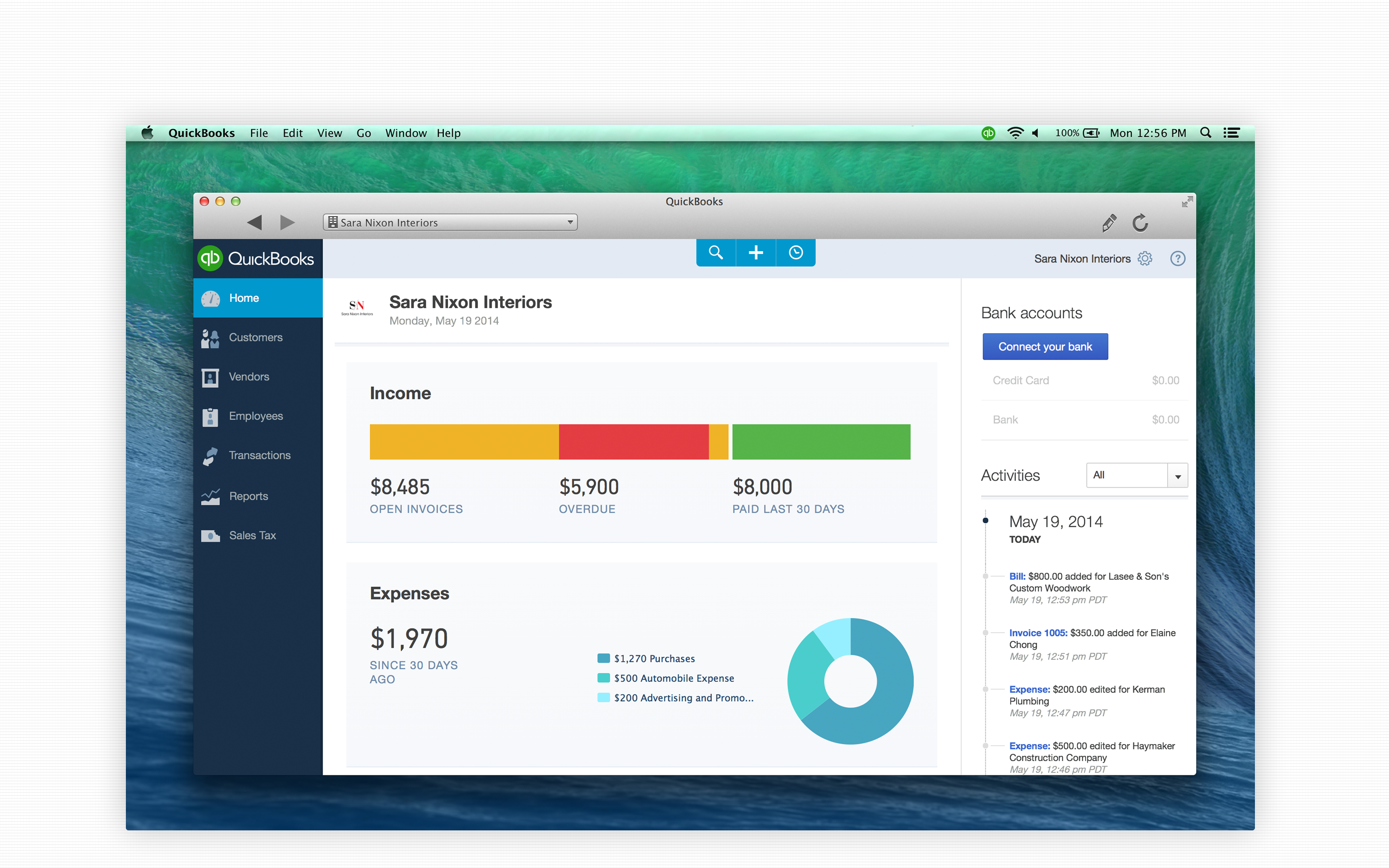
quickbooks mac app 01
QuickBooks app for Mac provides app-based access to your your Web-based QuickBooks Online data.
QuickBooks app for Mac should not be confused with QuickBooks for Mac 2014—it’s not a standalone application, and thus, requires that you already have an existing or plan to setup a new QuickBooks Online account, which is $13 to $40 per month. QuickBooks app provides a Mac-based frontend to the QuickBooks Online Web backend, something you would normally access using a Web browser.
This brings up an important note about QuickBooks app for Mac: At present it requires an active Internet connection. No Internet, no access to your data, although Intuit states that future versions of the app will allow you to work offline and sync changes to the Web once you’re connected again.
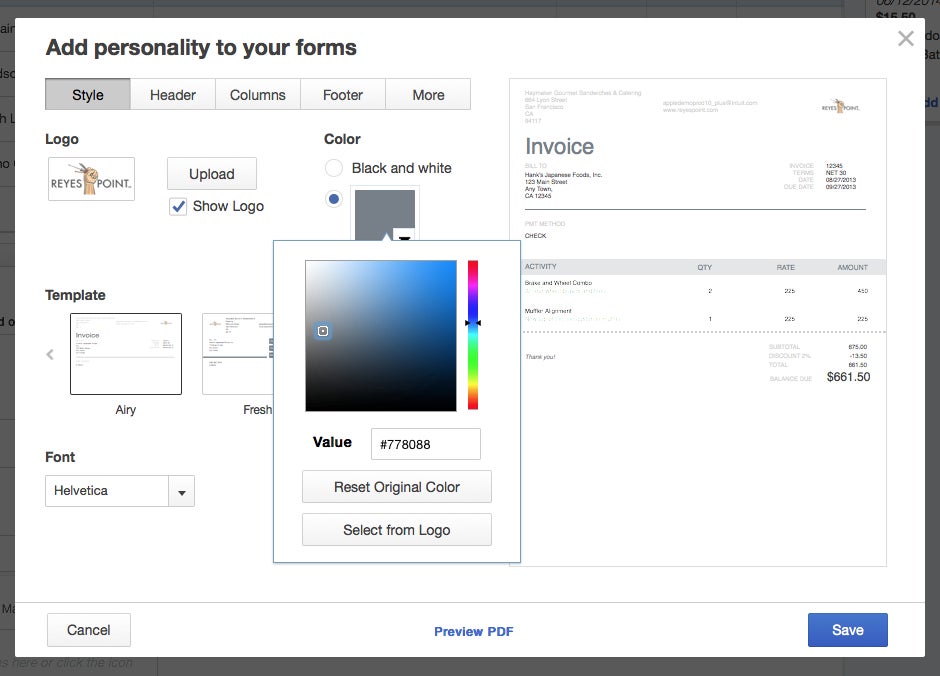
quickbooks mac app 02
Forms customization in QuickBooks app for Mac is smart, easy to use, and lets you create beautiful forms.
If you’ve used QuickBooks Online’s new interface, which rolled out to many QuickBooks Online users a month ago, the QuickBooks app for Mac interface will look familiar. QuickBooks app for Mac is a doppelgänger to QuickBooks Online’s new, less austere, graphically beautiful, and easy to master user interface. The app’s sidebar offers one-click access to QuickBooks Online’s accounting and business management tools. The app’s Home button provides a company overview that displays information on open, overdue, and recently paid invoices, current P&L and expenses. Displayed at the right of the screen is a list of all your accounts, their current balances and a number indicating how many unreconciled transactions each has.
Clicking anything you see on the Home screen takes you to the list of transactions associated with the item you’ve clicked. So, clicking the Overdue invoices link in the bar graph at the top of the QuickBooks app for Mac Home screen displays a list of all overdue transactions, where you can then select transactions and email the customers or print and send statements.
One of QuickBooks app for Mac’s outstanding features is forms customization (a feature also available in the new Web app). Forms have traditionally been a weak point in most every accounting application, whether on the Mac, PC, or the Web. Beautiful invoices were only possible with apps such as Marketcircle’s Billings Pro. QuickBooks app for Mac offers four very nice looking form templates that you can easily make changes to. Colors and font sizes are easily manipulated, although at present you only have access to two fonts. Also, upload your logo and the form is changed to reflect a color compatible with the dominant color in you logo.
quickbooks mac app 03
QuickBooks app for Mac give you an instant overview of your financial status.
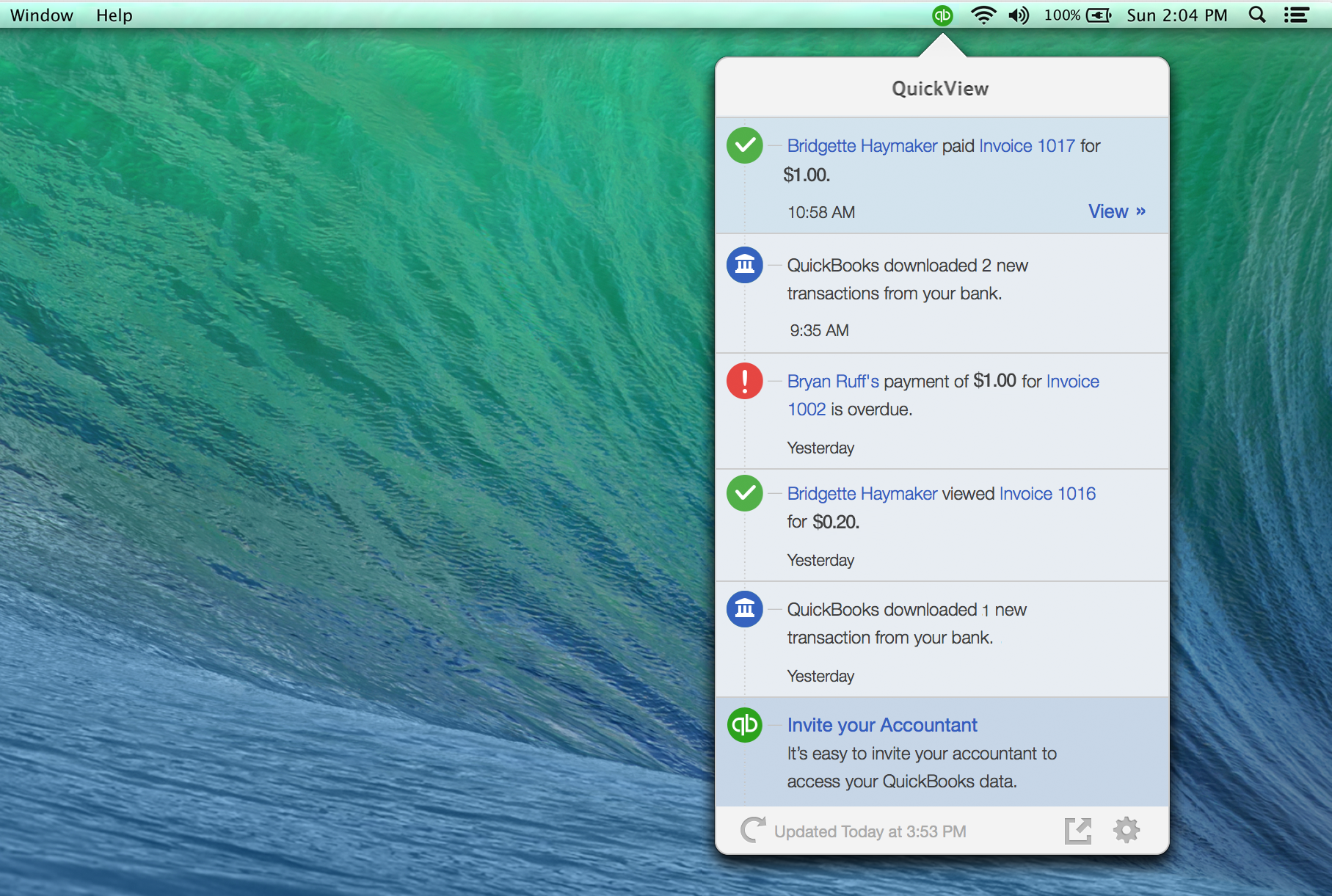
A couple of notes regarding some of QuickBooks app for Mac’s features. First, if you’re a current user of QuickBooks Online, some of the features mentioned in this review, such as forms customization, may not be available to you yet. This is also true of the app’s QuickView menu. QuickView is a menu extra that keeps you up-to-date on your business’ status without requiring that the app be open. At the time of this review Inuit was still testing this feature and, for some users, it may not appear as an option.
While part of the promise of the QuickBooks app for Mac is speed, in my testing, once the app was open, I saw no noticeable difference between the desktop and Web apps. The only real difference is how quickly the app opens and initially displays data. The Mac app is quite snappy, the Web app, not so much. But, to my mind, speed is not the app’s chief advantage. The advantage is the familiarity of using a Mac application rather than a browser-based a Web app. There are no bookmarks to save, there are no “favorite browser” compatibility issues you may encounter, you simply open the app and log in, as you do with any other Mac app.
QuickBooks app for Mac also has some minor annoyances, which are shared by the online app as well. Namely, Intuit persistently shills for QuickBooks Online features you haven’t yet “upgraded” to. You always see “to-do” items for setting up payroll services or links to set up Intuit’s credit card payment service. It’s not possible in either of these instances to hide these “offer” reminders. And, there is still no way to passively collect time billing information using a Mac or iOS app.
quickbooks mac app 04
The QuickView Menu lets you see important business information without requiring you to log in to QuickBooks Online.

Bottom line

QuickBooks app for Mac is an excellent tool for managing your QuickBooks Online data using an app on your Mac rather than an app within a Web browser. While it offers nothing new in terms of features, the simplicity of using a Mac app rather than a Web app and the QuickView menu’s ability to provide up-to-date business information without requiring you to log in to your QuickBooks Online account make QuickBooks app for Mac an excellent addition to what is already a very good business accounting application.
Posted on 6:41 AM | Categories:

GDpay, a leading merchant service provider, is now offering merchants the ability to process transactions directly in QuickBooks without using Intuit credit card processing.

GDpay, a leading merchant service provider, is now offering merchants the ability to process transactions directly in QuickBooks without using Intuit credit card processing. 

Many business owners that want to process credit card transactions directly in their Intuit QuickBooks accounting software mistakenly believe that their only merchant service options are through Intuit processing, such as Intuit’s mobile solution GoPayment or Intuit QuickBooks Payments. In actuality, this is not the case. Intuit credit card processing is more expensive than GDpay’s processing options, and despite commonly held beliefs, merchants integrating with QuickBooks software are not required to use it. GDpay now offers merchants the ability to process transactions with low-cost interchange plus pricing using a QuickBooks plug-in.

“Over the years I’ve noticed that almost all businesses use an accounting software such as QuickBooks, Sage, or a cloud-based accounting solution,” says GDpay Managing Director Kevin Yox. “We want these merchants to know that they are no longer forced to pay higher credit card processing fees as a price for the convenience of integrating with these systems. We now offer a solution that combines accounting integration with low processing fees.” 

The QuickBooks plug-in accounting integration now available through GDpay is versatile and includes a variety of features. Merchants may integrate with QuickBooks Pro, Premier, and Enterprise accounting software as long as they are using a Windows operating system. This accounting integration can be set up to apply transactions that are swiped, accepted online, or taken via a mobile device. There is also an option of setting up recurring transactions that can sync transaction data directly into QuickBooks.

The QuickBooks plug-in GDpay offers is capable of full accounting software integration and includes many time-saving features. Like Intuit GoPayment, the plug-in may be used in conjunction with Apple or Android devices to quickly and easily take swiped payments and then download those transactions into QuickBooks. Like Intuit QuickBooks Payments, the QuickBooks plug-in offered by GDpay is capable of taking payments directly in QuickBooks. Merchants may select invoices within QuickBooks and apply full or partial payments within the software. Merchants may also allow their customers to use secure online bill payment methods and then download these payments into QuickBooks for quick and easy record keeping.

GDpay reports that merchants who have taken advantage of the offer to integrate with or process directly in QuickBooks are very happy with the service so far, noting that this feature saves time and makes their accounting easier. Future releases include a sync function for QuickBooks Point of Sale system and QuickBooks Online cloud-based service.

“We are happy to see such a positive response from the merchants integrating their processing with QuickBooks at a rate lower than what Intuit offers,” says Kevin Yox. “We expect this to be a popular option for merchants since it provides such a value in terms of both time and money.”

For more information on GDpay, or to receive information on how you can process credit cards directly in QuickBooks, visit GDpay.com

About GDpay
GDpay is a privately held, self-funded ISO organization that has helped thousands of businesses in the United States find ideal payment solutions. GDpay offers credit card processing solutions ranging from traditional point of sale systems to ecommerce and mobile processing. GDpay.com provides educational tools so merchants will better understand credit card processing pricing structures and make educated choices when choosing a processor.
Posted on 6:29 AM | Categories: